The Farmer’s Cowl

This month’s free and easy Pattern for Homesteaders and Everyone Else! is The Farmer’s Cowl.

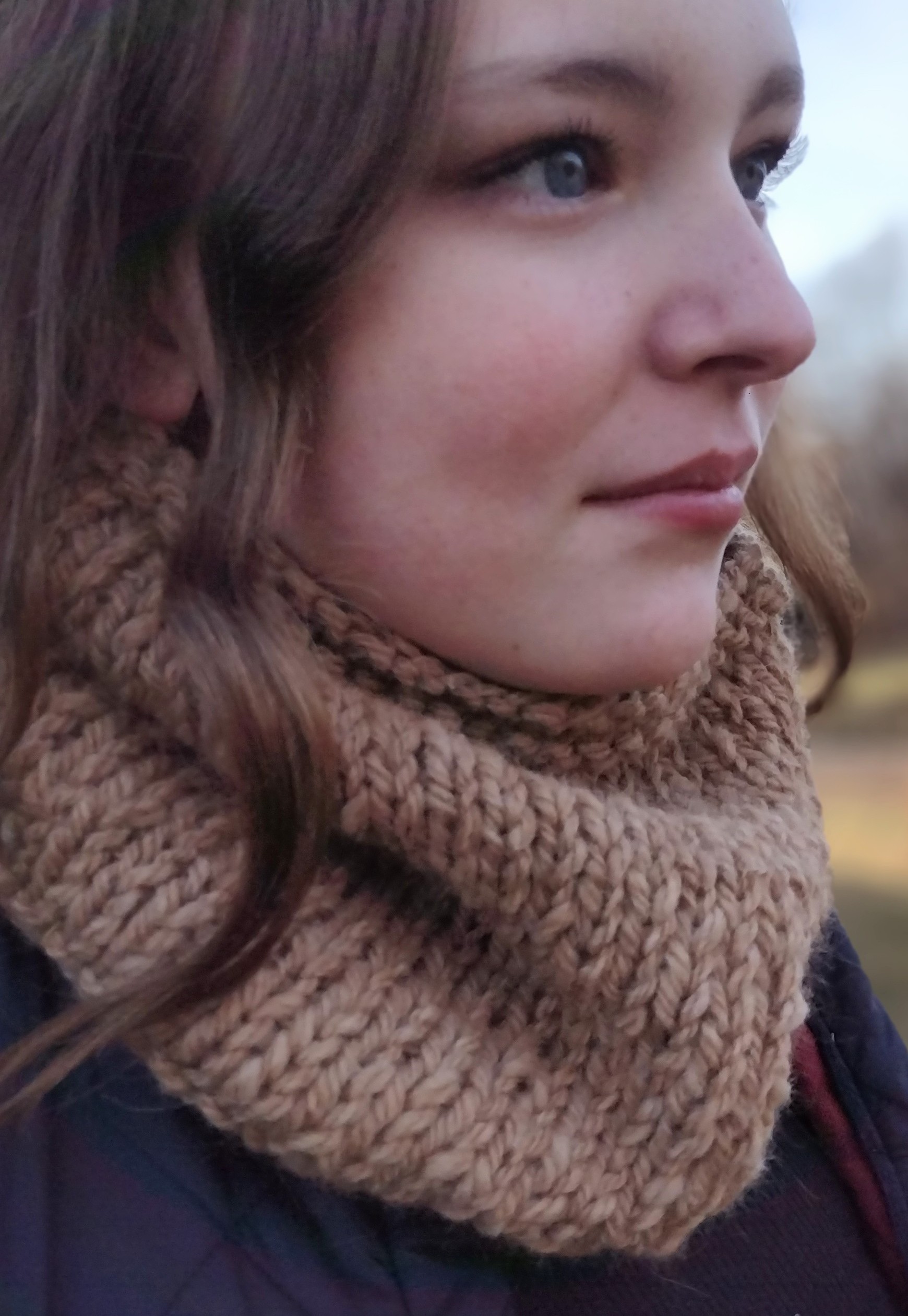
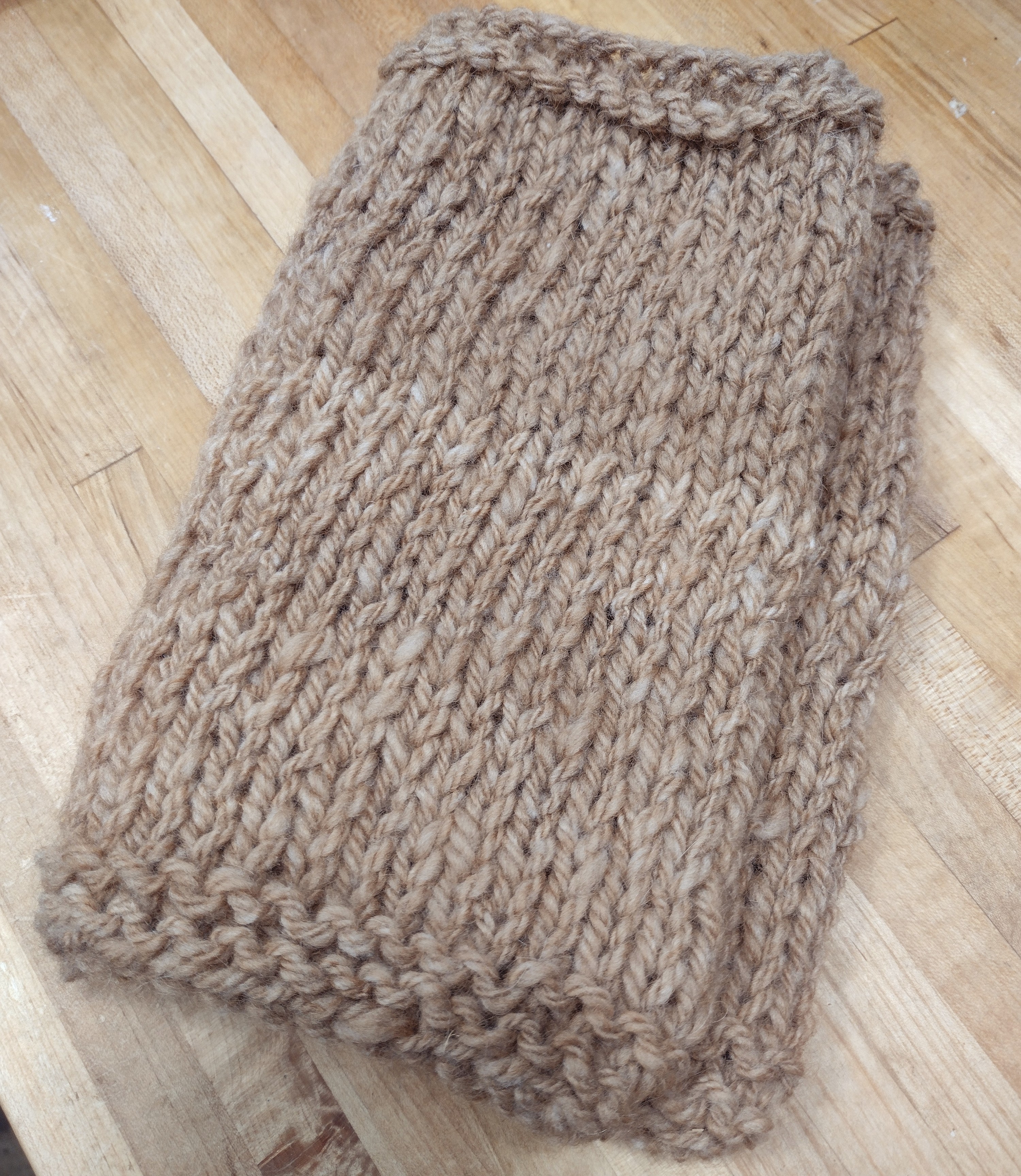
It’s the season for gifting, and this month’s cowl pattern is a quick knit and a great gift. This basic pattern can be fancied up in all sorts of ways – colorwork, cables, lace, etc – but for right now it is a few rows of garter stitch at top and bottom and several inches of stockinette in between. Essentially, you’ll be knitting a rectangle 24 inches wide and 10 inches high. You’ll sew one straight seam in the back of the cowl and you will have a fantastic winter layering piece ready for gifting to a loved one. You can also keep it and spoil yourself a bit. A nice warm cowl knitted with some lovely fleece makes all the difference when a cold wind is whipping and you need to feed the sheep.

Choose a soft yarn for this project since it’s likely going to be up against skin. If you’re not sure that a yarn is soft enough, hold it and/or rub it against your throat. Alpaca, alpaca blends, fine wools, and even some synthetics should be soft enough for next to skin wear. “Fine wool” is a pretty big category and if you’re new to knitting with wool, you generally can’t go wrong with yarns made from the Merino family; Merino, Rambouillet, Debouillet, etc. CVM/Romeldale is a heritage breed also known for producing very soft and beautiful wool. Shetland, Jacob, Hog Island, Finn, and some of the down breeds can all be very fine, but because there’s a lot of variability in each breeds’s wool you’ll want to select carefully.

I used some of my handspun yarn for the cowl. It’s 50% suri alpaca and 50% CVM lambswool. I spun fingering weight singles and then chain-plied them. The result is a heavy worsted/bulky weight yarn that knit up pretty fast on US 13 needles. I am not the world’s greatest chain-plier, but I love the slightly rustic texture that comes from knitting with imperfect yarn. If you’re buying yarn, look for something soft that will give you around 3-4 stitches per inch. You’ll want about 150 yards for this project. Gauge isn’t super important as long as you’re using a heavy weight yarn.

Download The Farmer’s Cowl pattern by Holly Callahan-Kasmala
New Series and an Easy Pattern

As gardeners/homesteaders/small farmers, we spend a lot of time thinking about the food and medicines that we consume. And that’s great! But, in my opinion, we don’t spend enough time thinking about the fibers we put in our homes and on our bodies. It’s wonderful to eat fresh foods, but how healthy are we really if we’re wearing things that are shedding microplastics into our water sources at the same time?

I’m introducing a series here on my website that will feature a free monthly pattern for anyone who wants to make their own textiles but isn’t very experienced yet. The majority of these patterns will be knitted rectangles that can be seamed into various garments. I’ll be using handspun yarn for the samples, but will make suggestions about what to look for if you’re buying commercial yarn. The goal of this project is slow cloth and slow fashion, just like the slow food movement.

If you’re new to knitting, or you’re a spinner who isn’t sure yet how to use the yarn you’ve created, then this series is for you! My goal is to share the type of patterns I would have loved to knit when I was starting out with fiber arts 20 years ago. These will be simple, useful designs that showcase the beautiful textures of handspun yarn, and put the power of cloth making into your own hands. I’ll alternate large and small projects so there’s something for every type of spinner and knitter.

These patterns are also knitted flat for the most part, which is easier for someone like me who has both nerve damage in my wrists and arthritis in my hands. I sometimes have a terrible time with double pointed needles, especially if they’re small.

If you don’t spin these patterns will still work for you! If you want to source handspun yarns or small mill produced yarns, the Livestock Conservancy’s Shave ’em to Save ’em program is a great place to start. I want people to feel free to use their wool (or any other fiber), or to source yarn from a local farm. For that reason, these patterns will not be fussy or too precious. They don’t have to be perfect, they’re meant to be used! Wear those mitts in the barn or to the farmer’s market. Making your own things can lead to a deep feeling of accomplishment and encouragement to try more new projects.

The fashion and textile industry creates as much as 10% of the world’s total pollution. That’s a staggering amount. In addition, up to 60% of the textiles created each year are plastic based. It may feel like your one pair of mitts is hardly a drop in the bucket, but it does make a difference.

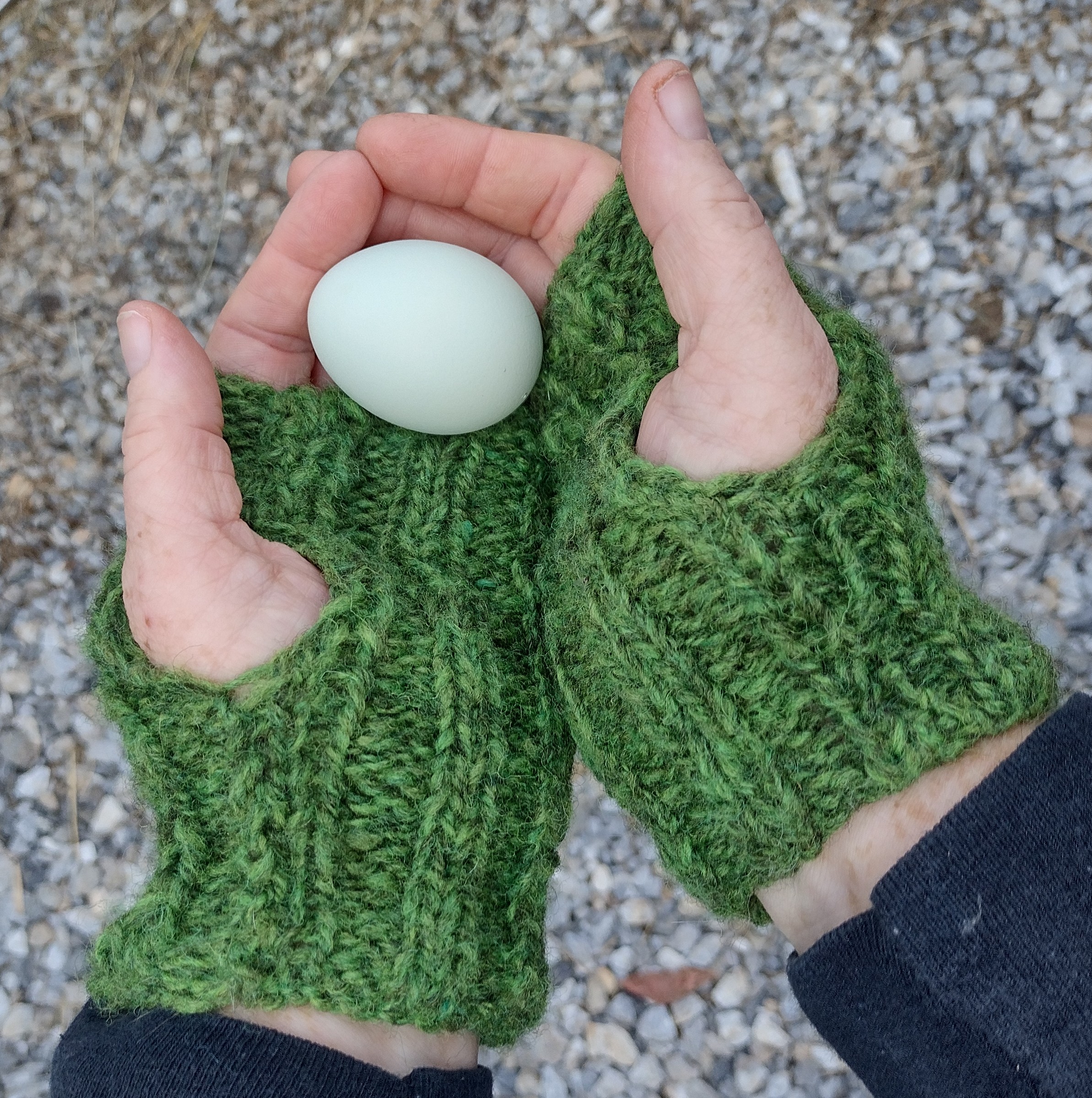
I have a few different patterns for fingerless mitts, but this is by far the simplest and easiest of them. You will knit two rectangles and sew one seam up the side of each, leaving a hole for the thumb. I wear my mitts every day while I do barn work for about 4 or 5 months of the year. I never used to believe that fingerless mitts did anything to keep your hands warm so I never bothered to knit any. With age has come some wisdom. Mitts keep your hands surprisingly warm and still leave your fingers free to collect eggs, give out treats, or just to use your phone or camera. Plus, they’re some of the oldest knitted garments out there.

The pattern for November, 2024 is Ribbed Barn Mitts.

Extremely Slow Fashion

The slow fashion movement has interested me for years. The philosophy behind it, understanding the origins and process behind your clothing and choosing those pieces least harmful to people, animals, and the planet, falls right into my own mission. It was this philosophy that, as a novice knitter, led me to learn how to spin fleece into yarn and eventually wind up with my own fiber-producing herd of llamas and alpacas.

These days knitting and crochet have become very popular and there are countless independent brands producing yarns from ethically sourced fleece and fiber. Thanks to sites like Etsy you can buy raw wool or carded/combed fleece directly from farms and other small companies. (Including my own!) The growth of DIY fiber arts and crafts has been another reflection of the slow fashion movement. What is slower and more worthwhile than spinning your own yarn and knitting a lovely sweater to your own specifications?

But, my journey through slow fashion has hit a major snag. And that is my current obsession with sewing. The way that we, as a global industry, produce fabric is the absolute opposite of earth friendly. For example, if you go to the average fabric store in any American city, you find lots of lovely fabric, and usually a sticker or note that says “made in America” or “made in China” but absolutely no information about the source of the fiber and where it was processed.

For example, you may find a nice cotton that says it was made in America. Great. But you don’t get the whole story. That cotton may have been grown in Texas, sent to China for processing, India for spinning, sent to Spain for dyeing, then sent back to the US for sale. That is most certainly not a small carbon footprint! If the fabric is to be used in the commercial garment trade it would have even more of a journey as it would probably end up someplace like Indonesia for cutting and sewing. For more about that, you can read this BBC article that was published 2 days ago.

If you were able to obtain the supply chain involved in the creation of your fabric, there are still big pieces missing. How was the fiber farmed? Was there heavy pesticide use, were the sheep treated well, were the workers paid a fair wage and treated decently? This kind of transparency is not only lacking, it is most likely completely impractical in our current global system of cloth production.

I’ve been researching this topic for months now and I’m no closer to finding a good solution. I could do what I did way back when I couldn’t find the yarn that I wanted. I learned to make it myself. I am a weaver, though I haven’t touched my loom in several years. And I do have plenty of fleece from the llamas and alpacas (and local sheep!) that would make lovely fabric. Doing it all myself would most definitely be slow! I’ll be exploring more options in the coming months and will record my ideas, experiments, and analysis here.

Most of them, anyway.